
Understanding Research Journal Quartiles
In academic publishing, journals are often categorized into quartiles to indicate their relative standing and influence within a specific field. For students seeking to publish research, understanding these quartiles is essential to evaluating the credibility and reach of potential publication venues.
In academic publishing, journals are often categorized into quartiles to indicate their relative standing and influence within a specific field. For students seeking to publish research, understanding these quartiles is essential to evaluating the credibility and reach of potential publication venues.
Definition of Quartiles
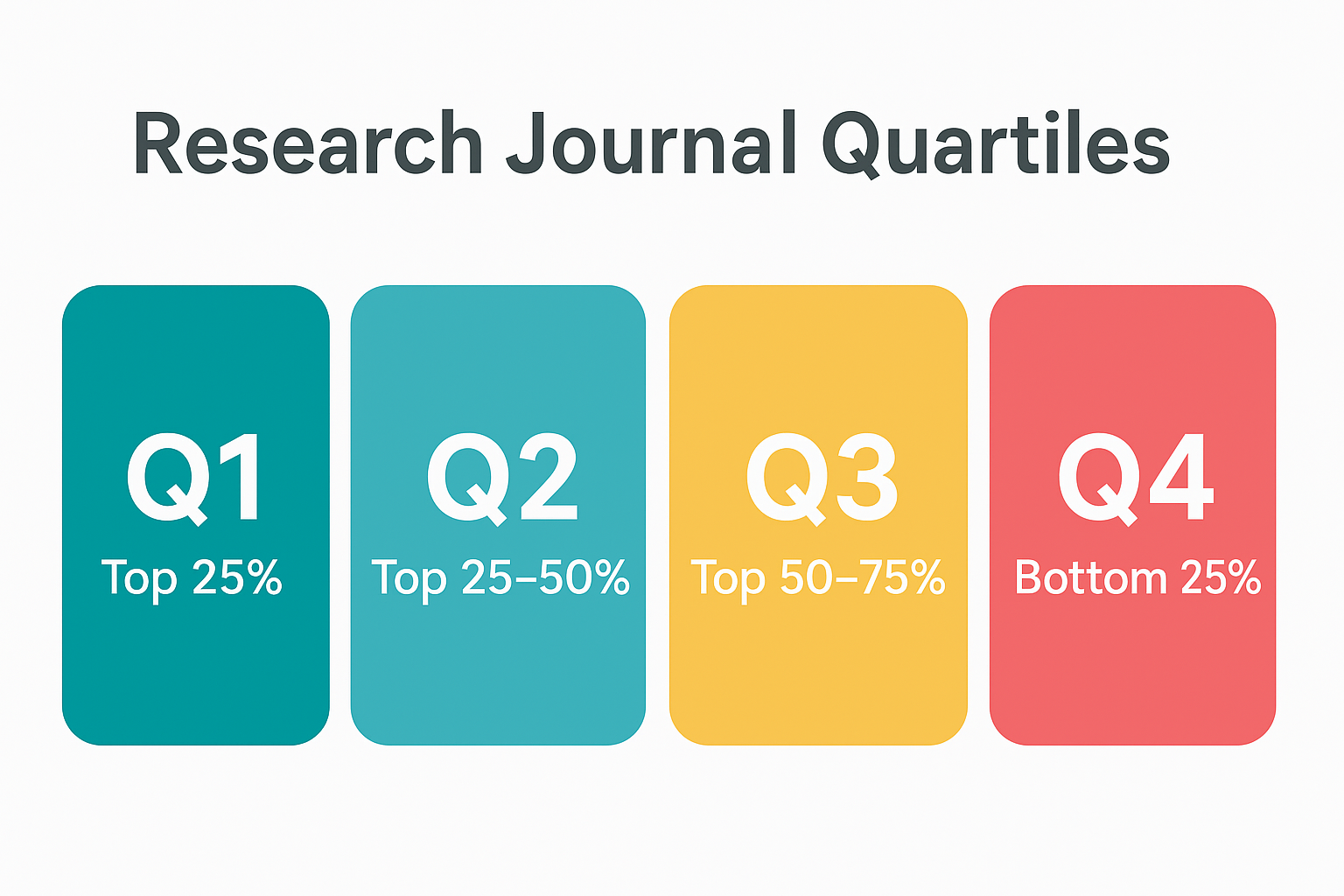
Quartiles divide journals into four ranked groups based on citation-based metrics, such as the Impact Factor or SCImago Journal Rank (SJR). These metrics are compiled by indexing services, including Scopus and Web of Science, and are widely recognized by the global academic community.
- Q1 (Top 25%) – Journals of the highest prestige in their field, characterized by strong citation records, rigorous peer-review processes, and broad readership.
- Q2 (Top 25–50%) – Well-regarded journals with high-quality publications and significant academic influence.
- Q3 (Top 50–75%) – Reputable journals that contribute meaningfully to their disciplines, often with more specialized or niche audiences.
- Q4 (Bottom 25%) – Valid, peer-reviewed journals that maintain academic standards but have comparatively lower citation metrics or reach.
Significance for Student Researchers
Understanding quartiles helps student researchers:
- Assess Journal Credibility – Higher quartile rankings often correlate with stricter editorial and peer-review standards.
- Select Appropriate Outlets – Choosing a journal that aligns with the scope and intended audience of a research project can increase the work’s visibility and impact.
- Avoid Predatory Journals – Recognized quartile rankings can help identify legitimate journals and avoid those that lack rigorous academic oversight.
Examples of Well-Respected Journals
While rankings change over time, some journals are widely recognized for their influence and credibility:
- STEM: IEEE Transactions on Pattern Analysis and Machine Intelligence, Journal of the American Chemical Society
- Social Sciences: American Journal of Sociology, Social Science Research
- Humanities: PMLA (Publications of the Modern Language Association), Critical Inquiry
A Balanced Perspective
While quartile rankings provide valuable guidance, they should not be the sole factor in selecting a publication venue. For high school students, the educational experience—developing research skills, engaging with academic mentors, and navigating the publication process—holds equal or greater importance than the journal’s position in the ranking system.
Our Commitment
At Meaningful Thinking, we equip high school students with the resources, mentorship, and guidance necessary to conduct impactful research and successfully navigate the academic publishing process. Whether the final work appears in a Q1 or Q4 journal, our focus remains on fostering intellectual growth, analytical skills, and a deep understanding of the research landscape.